

Elizabeth “Lizzy” Hane is a second year PhD student in the Department of Religion. Her research broadly concerns conceptions of race and gender in ancient Christian communities of the Eastern Roman Empire. She reflected on the Program in the Ancient World’s Spring 2026 Magie Lecture.
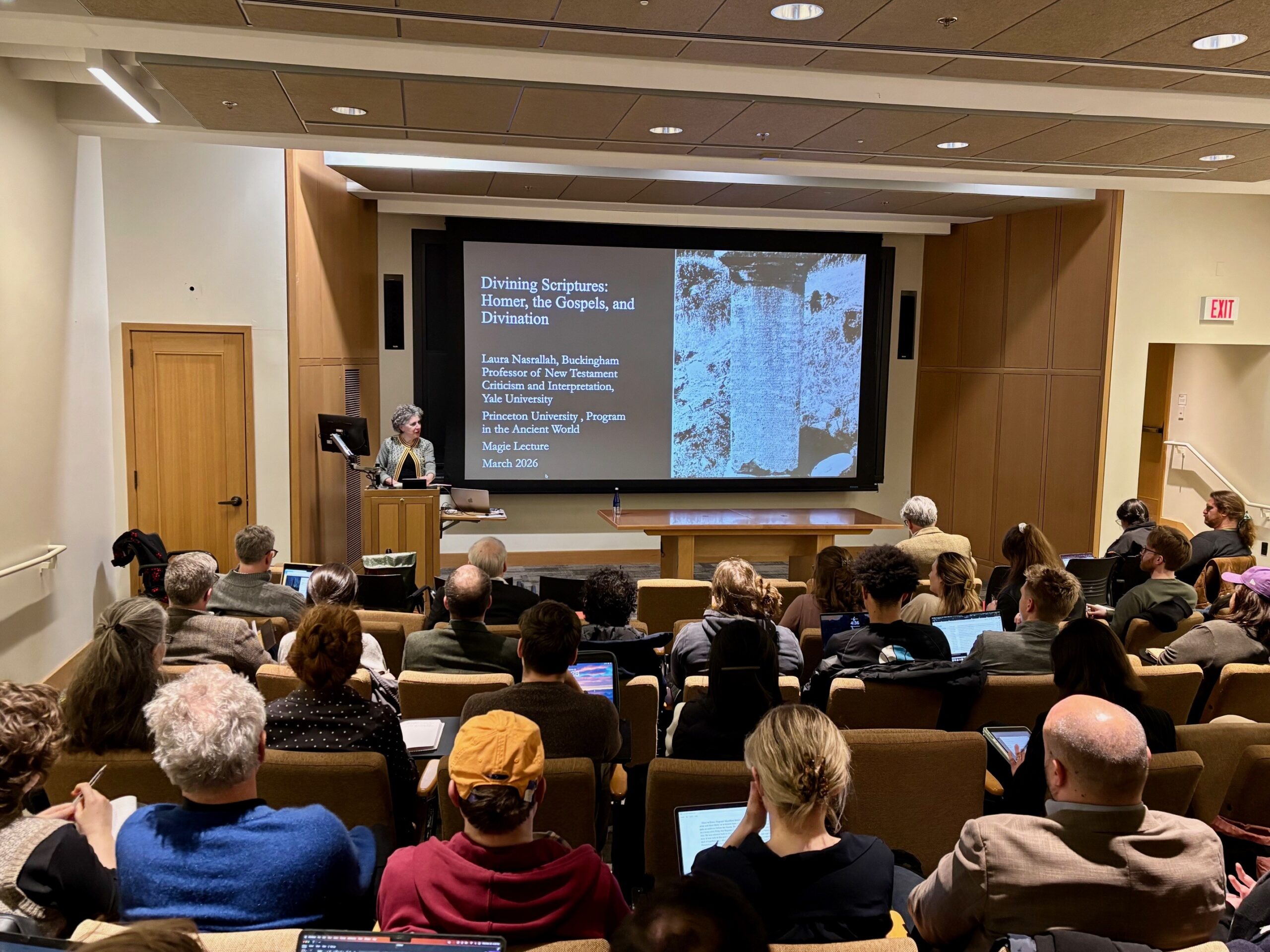
Laura S. Nasrallah, the Buckingham Professor of New Testament Criticism and Interpretation at Yale University, visited Princeton recently to speak about her upcoming work on divination machines. In the PAW Magie Lecture, held on March 25, Professor Nasrallah opened with a haunting recitation of Elizabeth Bishop’s “At the Fishhouses,” drawing listeners into the ‘bitter’ ‘briny,’ and ‘burning’ taste of history. Her focus, however, was how randomization of scripture and Homeric verse could be used in fortune telling and predictive ritual practices.
Building out of Visiting IAS Member Jeremiah Coogan’s work on writing culture and Princeton’s William H. Danforth Professor of Religion AnneMarie Luijendijk’s work on Christian usage of oracular manuscripts, Professor Nasrallah examined how sortilege technologies reveal everyday interactions with the divine through material mechanisms. These sortilege practices, however, could also illustrate alternative ways of conceptualizing canons. Professor Nasrallah, who takes her students to Greece and Turkey every few years as part of her course “Archaeology of the Roman Empire for the Study of New Testament and Early Christianity,” also recounted her adventurous encounter with the longest Greek inscription of Diogenes of Oenoanda—hidden far atop a mountain in southwest Turkey—and how this inscription plays with both the landscape and nearby cityscape to impart randomized, divined fortunes onto passerbys.
Professor Nasrallah also spoke with graduate students at a lunch event. Students asked questions about forgeries, reconstructing historical voices, and magical practice in the ancient world over sandwiches and soft drinks. Professor Nasrallah spoke generously about how she works through questions and writes, as well as her thoughts about the work done at universities.
On Thursday, speaking with undergraduate students at a guest lecture for Professor Luijendijk’s course REL 252 Jesus: How Christianity Began, Professor Nasrallah echoed previous conversations about how we can creatively address epistemological gaps in the historical record through visual art and poetry. She also reflected on how her time as an English major at Princeton has shaped her work as a scholar of religion—including in her aforementioned citation of Elizabeth Bishop.
Professor Nasrallah most recently published Ancient Christians and the Power of Curses: Magic, Aesthetics, and Justice, which explores matters of justice and ritual in the ancient world. Borrowing poetry and contemporary art from Black American poets, artists, and creatives, the book delves into the language and phrases of curse tablets, and especially how Christians responded to their usage in the ancient world as devices of restitution and retribution. Her interest in so-called ancient magic began with her dissertation and first book, An Ecstasy of Folly, which focused on responses to fortune telling in ancient Christianity. Over 20 years later, she has continued to make brilliant, cutting-edge, and creative advancements in the field of New Testament, leveraging material culture and critical theory to think about the ancient world in its full mosaic of ritual practices.